How to Choose the Best New Energy Car for Your Needs?
Choosing the right New Energy Car can be daunting. With so many options available, making a decision requires careful consideration. Expert John Doe, a renowned figure in the automotive industry, once stated, "Selecting a New Energy Car means understanding your own needs first." This perspective emphasizes the importance of personal requirements.
When considering a New Energy Car, think about your driving habits. Do you commute daily or take long trips? Battery range and charging time become crucial factors in your decision. Furthermore, consider the vehicle's size. A compact car may be ideal for city driving. However, families may need a spacious model.
Reflection on your lifestyle will guide you. For example, some may prioritize eco-friendliness over performance. Others may seek advanced tech features. Each choice impacts your experience. It’s essential to weigh these details. The market is evolving, and the future of New Energy Cars looks promising but complex. Understanding your preferences will lead to a better choice.

Factors to Consider When Choosing a New Energy Car
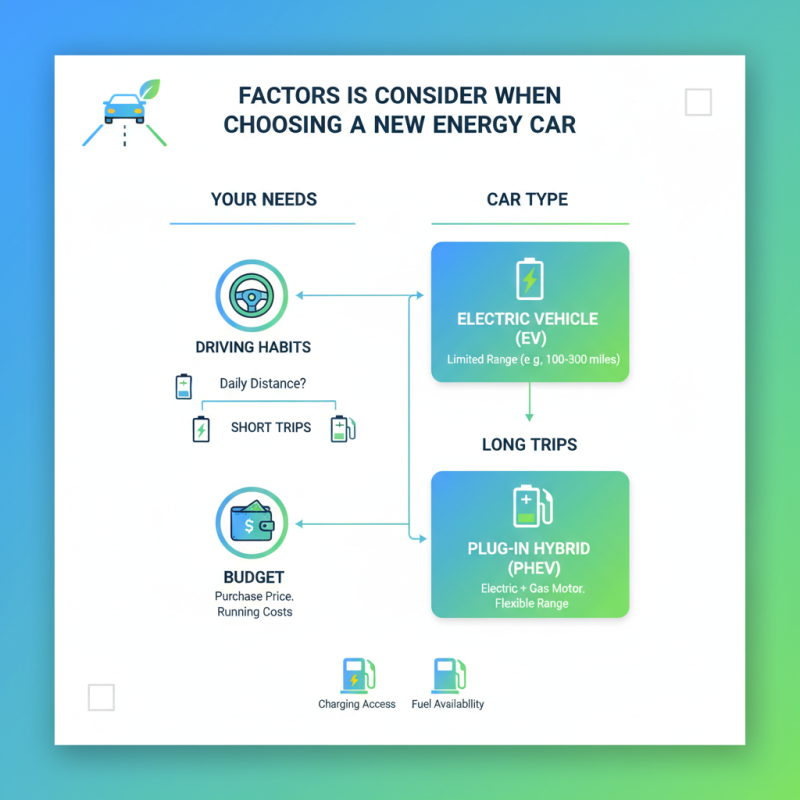
Choosing a new energy car can be overwhelming. Several factors demand your attention. First, consider your driving habits. How far do you typically drive each day? If you often exceed the range of electric vehicles, you might need a plug-in hybrid. These can offer flexibility.
Next, think about charging options. Do you have a home charging station? If not, access to public chargers becomes crucial. Research charging speeds in your area. Some chargers are faster than others, and it can significantly impact your daily routine.
Also, take note of the total cost of ownership. Look beyond the purchase price. Consider insurance, maintenance, and potential incentives for driving a new energy car. Each model may come with hidden costs or savings. Reflection on your lifestyle is essential. A vehicle is an investment, and the right choice should align with your needs. Make your decision wisely.
Comparison of Electric Vehicle Types: BEVs, PHEVs, and HEVs
When choosing a new energy car, it helps to understand the different types available. Battery Electric Vehicles (BEVs), Plug-in Hybrid Electric Vehicles (PHEVs), and Hybrid Electric Vehicles (HEVs) each serve unique needs. BEVs run solely on electricity. They offer a quiet ride and zero emissions. However, their charging times can be inconvenient. PHEVs combine a gas engine and electric motor. They provide flexibility but may have limited electric range. HEVs use both gas and electricity but rely more on fuel. They are a good option for those who drive longer distances.
Tips: Consider how you use your vehicle. Do you drive short daily commutes, or do you take long trips? Evaluate charging infrastructure in your area. Additionally, think about your lifestyle. An electric-only option might require adjustments. It’s essential to reflect on your driving habits and the available resources.
While BEVs may seem appealing, accessibility to charging points varies. PHEVs offer a balance but can be complex to maintain. Hybrid options often lack the excitement of fully electric driving. Understanding these nuances can guide your choice. Before making a decision, gather information and weigh your preferences.
Understanding Battery Technology and Range: Key Metrics for Performance
When selecting a new energy car, battery technology significantly impacts performance. Lithium-ion batteries dominate this market, accounting for around 80% of all electric vehicle batteries. These batteries are known for their energy density, which typically ranges between 150 to 250 Wh/kg. Higher energy density means a longer driving range. However, it is essential to consider that not all batteries perform equally under different conditions.
Range anxiety is a common concern among potential buyers. Most electric vehicles offer a range of 120 to 370 miles on a single charge. However, real-world conditions like temperature and driving habits can reduce this range substantially. For example, colder climates may decrease the overall efficiency by up to 40%, which is critical to consider in your choice.
Charging time is another metric that affects daily usability. DC fast charging can charge a car to 80% in about 30 minutes. Yet, this is not universally available. Many consumers might find themselves with a Level 2 charger, which takes about 4 to 8 hours for a full charge. This slower option can be a serious drawback for those with limited charging infrastructure. Thus, assessing your daily needs and local charging options becomes crucial in making an informed decision.
How to Choose the Best New Energy Car for Your Needs? - Understanding Battery Technology and Range: Key Metrics for Performance
| Model |
Battery Capacity (kWh) |
Range (miles) |
Charging Time (hrs) |
Efficiency (Wh/mile) |
| Model A |
75 |
250 |
7.5 |
300 |
| Model B |
85 |
270 |
6.8 |
315 |
| Model C |
100 |
300 |
8 |
333 |
| Model D |
60 |
220 |
5 |
272 |
| Model E |
95 |
290 |
7 |
328 |
Evaluating Charging Infrastructure: Availability and Types of Chargers
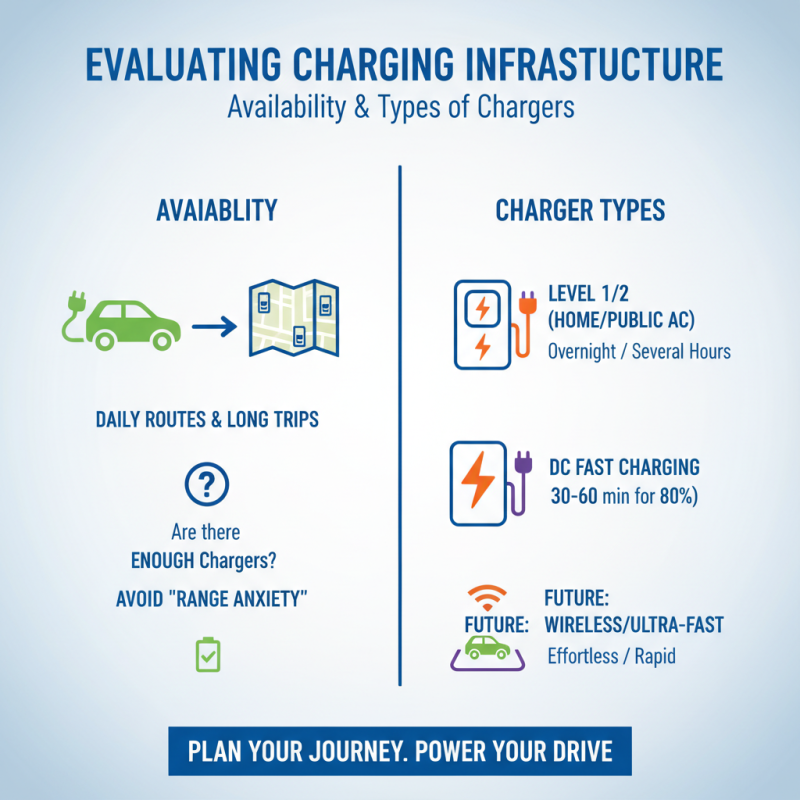
When considering a new energy car, charging infrastructure is crucial. The availability of charging stations can significantly impact your experience. Are there ample chargers along your daily routes? Knowing this can save you from running low on battery during critical times.
Tip: Use online maps to locate nearby charging points. Check how many fast chargers are available. Fast chargers can replenish your battery in a shorter time, which is indispensable for long drives.
Different types of chargers exist. Level 1 chargers, for instance, are common in homes but are slow. Level 2 chargers are faster and found in public locations. DC fast chargers deliver high power, rapidly charging your vehicle. Understanding these can help you plan.
Tip: If you travel frequently, seek areas with DC fast chargers. Choose a car that matches the charging types available near you. Take notes on what works best for your routine. Reflect on your charging habits, and adjust them as needed.
Cost of Ownership: Analyzing Purchase, Maintenance, and Resale Values
When choosing a new energy car, cost of ownership is crucial. You need to consider purchase price, maintenance, and resale value. The initial cost can vary significantly. Some models are cheaper upfront, but they might cost more to maintain. Others could be pricier initially but save you money in the long run.
Maintenance costs can sneak up on you. Electric vehicles often require less upkeep, like no oil changes. However, battery replacements can be expensive. Researching potential repair costs is vital. Many drivers overlook this aspect and end up spending more than anticipated.
Resale value is another key factor. Some models depreciate quickly, while others hold their value better. Look at market trends before making a decision. Real estate is similar; location matters. An energy car’s reputation plays a role, too. Some have a strong resale market, while others do not. Investing time in this research pays off.

 T5EVO
T5EVO T5L
T5L T5
T5 Friday
 T5 HEV
 V9
V9 UTOUR (M4)
 M5 EV
M5 EV M5
M5 Lingzhi Plus
 S7
S7 V9 HEV
 S7
S7 6X4 H7 Tractor
 6X4 H5 Tractor
 6X4 HK Tractor
 4X2 H7 Tractor
 4X2 H5Tractor
 4X2 H5 Cargo Truck
 4X2 M3 Cargo Truck
 4X2 L2 Cargo Truck
 6X4 H7 Dump Truck
 6X4 H5 Dump Truck
 4X2 H5 Dump Truck
 4X2 M3 Dump Truck
 Light Truck L2
 Light Truck L2 EV
 H7 Refrigeratior Truck
 H5 Mixer Truck
 M3 Tank Truck
 M3 Sanitation Truck
 6X4 H7 Electric Truck
 4X2 H5V Electric Truck
 4X2 L2 Electric Truck